The Crash of 1929
Stock prices have reached what looks like a permanently high plateau… I do not feel there will be soon, if ever, a 50 or 60 point break from present levels, such as (bears) have predicted. I expect to see the stock market a good deal higher than it is today within a few months.
Yale Professor Irving Fisher, October 15, 1929
The stock market crash in 1929, which ignited the wrenching Great Depression, was one of the most important events in the history of the stock market. The stock market traces its origin to the Buttonwood Agreement in 1792, when 24 New York stockbrokers and merchants signed an agreement under a buttonwood tree on Wall Street. Twenty-five years later, brokers drafted a constitution which formally created the New York Stock and Exchange Board. Over the more than two centuries in which the stock market has been in existence, the crash of 1929 has come to be seen as one of the defining events in the storied history and folklore of the market.
Last year, Andrew Ross Sorkin published 1929: Inside the Crash, a book which takes the reader behind the scenes of the stock market crash, focusing primarily on the lives and actions of the main players in the drama. It is written in an engaging manner and is historically well researched. Sorkin is one of the three well-known stock market commentators on CNBC’s early morning TV show, Squawk Box. He is also author of the 2009 book, Too Big to Fail, chronicling the events of the Financial Panic of 2007-2009 that brought the world financial system nearly to a standstill.
In this investment commentary, we tell the story of the collapse of the stock market in 1929, drawing not only from Sorkin’s 1929 but also from John Kenneth Galbraith’s seminal work, The Great Crash of 1929. Galbraith’s book focuses less on the lives and behavior of the chief actors in the drama and more on the macroeconomic events and stock market characteristics at that time.
In the concluding section of this essay, we seek to answer questions about whether the current stock market is setting up for a similar market crash. The current 17-year secular bull market, which commenced in March 2009, has seen the total return of the S&P 500 advance over thirteenfold thus far. And, as we have often written before, all good things come to an end … as least for a while. Or as the Germans put it, Die Bäume wachsen nicht in den Himmel (trees do not grow to heaven).
Run-up to the 1929 Stock Market Crash
The 1920s were a very prosperous time for many Americans. In Calvin Coolidge’s administration, Treasury Secretary Andrew Mellon championed sweeping tax reforms in 1924 and 1926. The top marginal tax rates were cut from 73% to 25%, and the effect of these tax cuts, together with other economic measures, caused government revenues to actually increase during the administration. This enabled the government to pay down debt by one-third. The result of these economic policies was the “Roaring 20s.” Although farmers continued to suffer from the post-World War I period of 1920-1921, when crop prices were cut sharply, it was generally a period of great optimism. Automobiles, telephones, and radios proliferated. The Federal Reserve Index of industrial production, which averaged 67 in 1921, rose to 126 by June 1929. There were 5.4 million automobiles produced in 1929 ‒ roughly the same number as in 1953.
The 1920s were also a period when many Americans were displaying an overwhelming desire to get rich quickly. An example of this was the 1925 Florida land boom ‒ a classic speculative bubble ‒ which burst when the pool of buyers dried up, causing prices of lots to fall as much as 90%. In 1920-1921, the U.S. economy suffered a deflationary contraction following World War I during which the Dow Jones fell from 104 in early 1920 to 71 by September 1921 ‒ a drop of over 30%. But by August 1924, the Dow Jones had bounced back to 104. Then the stock market really took off. During the next five years, culminating in September 1929, the Dow Jones advanced 324% (with dividends reinvested). The chart below tells the story of the market in the 1920s:
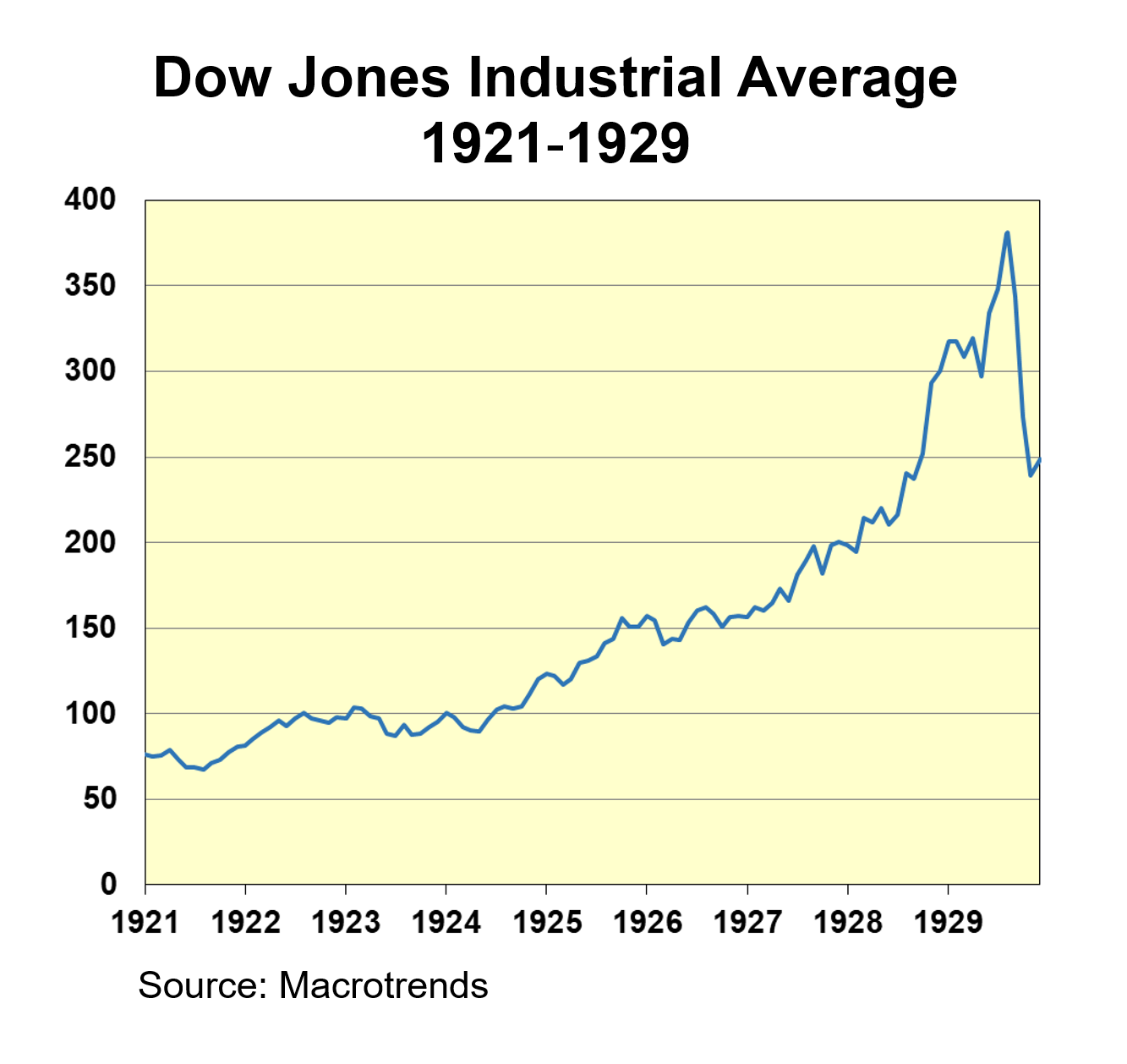
As the chart above demonstrates, the stock market rose almost 75% from August 1924 through year-end 1925. Although there were some small setbacks in 1926 causing the Dow to end the year essentially where it had started, the stock market advanced steadily in 1927, helped by the Federal Reserve Bank cutting its rediscount rate from 4% to 3.5%. It was in 1928 when the stock market really took off. In his book, 1929, Sorkin reports that margin debt, which at the start of the decade was $1 billion, reached $6 billion when mass speculation began in earnest in 1928. Radio Corporation of America (RCA), the glamor stock of the time, advanced from $5.80 a share at the start of the decade to $420 in 1928. It rose over 400% in 1928 alone, as investors saw a limitless future for RCA. The trading volume in the number of shares increased dramatically in 1928. The average daily trading volume in 1927 was approximately 1.8 million shares; on June 12, 1928 trading volume exceeded 5 million shares for the first time. The ticker fell nearly two hours behind the market. A growing tide of speculation engulfed the nation. The New York Times industrial average (composed of 25 leading industrial corporations such as GE, GM, U.S. Steel, and Westinghouse, and retail companies like Woolworth), rose 35% in 1928.
Buying Stocks on Margin
One of the main features of the growing speculation in the stock market during the 1920s was the use of margin to buy stocks. At most brokerage firms, investors needed to put up only 10% of the cash necessary to purchase a stock. For example, in order to buy 100 shares of a stock trading at $100 a share, the investor (speculator) only needed to use $1,000 of his or her own money and could borrow $9,000 to complete the $10,000 purchase. The brokerage firms borrowed money from banks (so-called broker loans) and corporations to facilitate buying stocks on margin. Buying stocks on margin of only 10% could result in either spectacular gains or losses. If a client utilized this level of margin, the brokerage firm would issue a margin call to the client, demanding more cash, if the stocks in a client’s portfolio dropped 10% or more. And if more cash was not immediately forthcoming, the brokerage firm would sell stocks in order to reduce or eliminate the client’s margin loan. Buying stocks with only 10% down was obviously a very risky business, as speculators were soon to find out in the last months of 1929.
Investment Trusts
In the 1920s, a number of so-called investment trusts were created. Many retail investors saw investment trusts as the way to invest in the stock market, because they could invest smaller amounts of capital in a diversified portfolio by buying units or shares. Unlike modern diversified mutual funds, these trusts were generally not well-diversified and operated like unregulated hedge funds. They were usually leveraged, using large amounts of borrowed money to enhance gains. Some of the more well-known trusts of the late 1920s were Goldman Sachs Trading Corporation, Shenandoah Corporation, Alleghany Corporation, Blue Ridge Corporation, United Founders, and Insull Utility Investments. They often invested in each other’s investment trusts. These interlocking, highly speculative investment trusts created a dangerous financial house of cards. Approximately 186 investment trusts were organized during 1928, and 300 investment trusts existed by 1929. Most of them lost 95% or more of their value and either closed down or went bankrupt during the Crash, with their investors losing everything.
The Bubble Continues to Inflate
Some leading economic and banking leaders saw that the bubble in the stock market was inflating too rapidly; the question was how to find a way to let it deflate gradually. One of the first attempts to counter the rampant speculation was made by the New York Federal Reserve in February 1929 when they proposed raising the rediscount rate from 5 to 6 percent. Neither the Federal Reserve Board in Washington nor President Hoover supported this move, and no action was taken. By March, the Federal Reserve was meeting daily in Washington and even met on an unprecedented Saturday, which shook the confidence of stock market investors. A record 8.2 million shares traded on Tuesday, March 26, as prices dropped dramatically. That morning, call money on broker loans reached 20%. The bubble would probably have deflated at that point, except Charles E. Mitchell stepped into the breach. Mitchell was president of National City Bank of New York, the largest bank in the country, and likewise a director of the Federal Reserve Bank of New York. He was all in favor of the boom in the stock market. On March 26, as interest rates rose and stock prices fell, Mitchell announced that to avert “any dangerous crisis in the money market,” National City would loan money as necessary to prevent this looming crisis. His words were like magic. By the end of the trading day, interest rates had eased and prices had rallied. The next day, National City stated that it would inject $25 million into the call market. Most of the directors of the Federal Reserve Bank of New York were highly critical of Mitchell, as he was acting in opposition to the bank’s efforts to curtail speculation. As investors were able to access adequate liquidity to buy stocks on margin at reasonable interest rates, the stock market sailed on, advancing strongly until September. Between the beginning of 1929 and the market peak on September 3, 1929, the Dow Jones Industrial Average gained approximately 24%. Rarely had so many become rich so quickly and effortlessly ‒ especially those who were buying on margin. For someone borrowing on 50% margin, a 24% gain equated to a 48% bonanza.
In August 1929, the Federal Reserve Board in Washington finally agreed to increase the rediscount rate from 5% to 6%. Despite their effort to contain stock market speculation, there was no shortage of stock market bulls and optimists about the economy. The famous speculator, Bernard Baruch, told Bruce Barton in a famous interview in The American Magazine that “the economic condition of the world seems on the verge of a great forward movement.” The well-known Princeton professor, Joseph S. Lawrence, announced that “the consensus of judgment of the millions whose valuations fluctuate on that admirable market, the Stock Exchange, is that stocks are not at present overvalued.” The most egregiously wrong statement, which is highlighted at the beginning of this essay and remembered even today, was uttered in the autumn of 1929 by the famous Yale professor, Irving Fisher: “Stock prices have reached what looks like a permanently high plateau.”
According to Galbraith, approximately 1.5 million people in the U.S. (representing perhaps 30 million families) had brokerage accounts in 1929 out of a total of 120 million people. And not all were speculators. Brokerage firms, testifying before Congress after the crash, stated that only 40% of the accounts ‒ 600,000 ‒ were margin accounts. Including many operators, who ran pools or had multiple accounts, there were perhaps one million margin accounts. The number of investors and speculators represented a rather small percentage of American citizens. But by the summer of 1929, the stock market not only dominated the national news; it became central to the culture. Brokers’ offices were crowded from 10 a.m. to 3 p.m. with customers seated or standing watching the prices being chalked up on the blackboard. Shoeshine boys and chauffeurs talked about the market. There were even brokerage offices on passenger ships crossing the Atlantic.
The stock market peaked on September 3, 1929, with the Dow reaching 381. On September 5, Roger Babson, speaking before the Annual National Business Conference, opined: “Sooner or later, a crash is coming, and it may be terrific.” He went on to say that “factories will shut down … men will be thrown out of work … and the result will be a serious depression.” Yet few paid much heed to Babson, who was derided as the “Sage of Wellesley” in a Barron’s editorial on September 9, 1929. The article noted the “notorious inaccuracy” of his past statements. The Dow ended the month of September slightly down.
October 1929 — The Bubble Bursts
During the early days of October 1929, the stock market began to act poorly, as investors intensified their selling of stocks. On Monday, October 21, 6.1 million shares were traded ‒ the third greatest volume in history. There was so much activity that the ticker tape was an hour and 40 minutes late by the close of trading. During the afternoon of the 23rd, an unexpected decline in stock prices began about an hour before trading ended for the day, leading to a 4.6% drop in total market value. Then, on October 24, the panic of 1929 began. On that day, “Black Thursday,” the market lost 11% of its value at the opening bell. Once again, the ticker tape fell hours behind, and the uncertainty led investors to sell. With the market’s collapse, brokers sold stocks to repay margin loans. A crowd gathered on Broad Street outside the Exchange. By noon, reporters learned that a meeting of leading bankers was taking place at the offices of J.P. Morgan to try to find a solution to the panic. The senior partner at Morgan, Thomas Lamont, hosted the meeting which included such luminaries as Charles Mitchell, chairman of National City Bank; Albert Wiggin, chairman of Chase National Bank; William Potter, president of the Guaranty Trust Company; and Seward Prosser, chairman of the Bankers Trust Company. When the meeting broke up, Lamont met with reporters and informed them that the bankers were pooling resources to support the market. Richard Whitney, vice president of the Stock Exchange but serving as acting president at the time, was chosen to go onto the floor of the stock exchange and place a bid to buy 25,000 shares of U.S. Steel as well as similar bids on other blue-chip stocks. The effect was electric; fear vanished and prices stabilized and then went higher. The Dow closed lower by only 2.1% on the day. Friday and Saturday again saw heavy trading, but prices were steady in general.
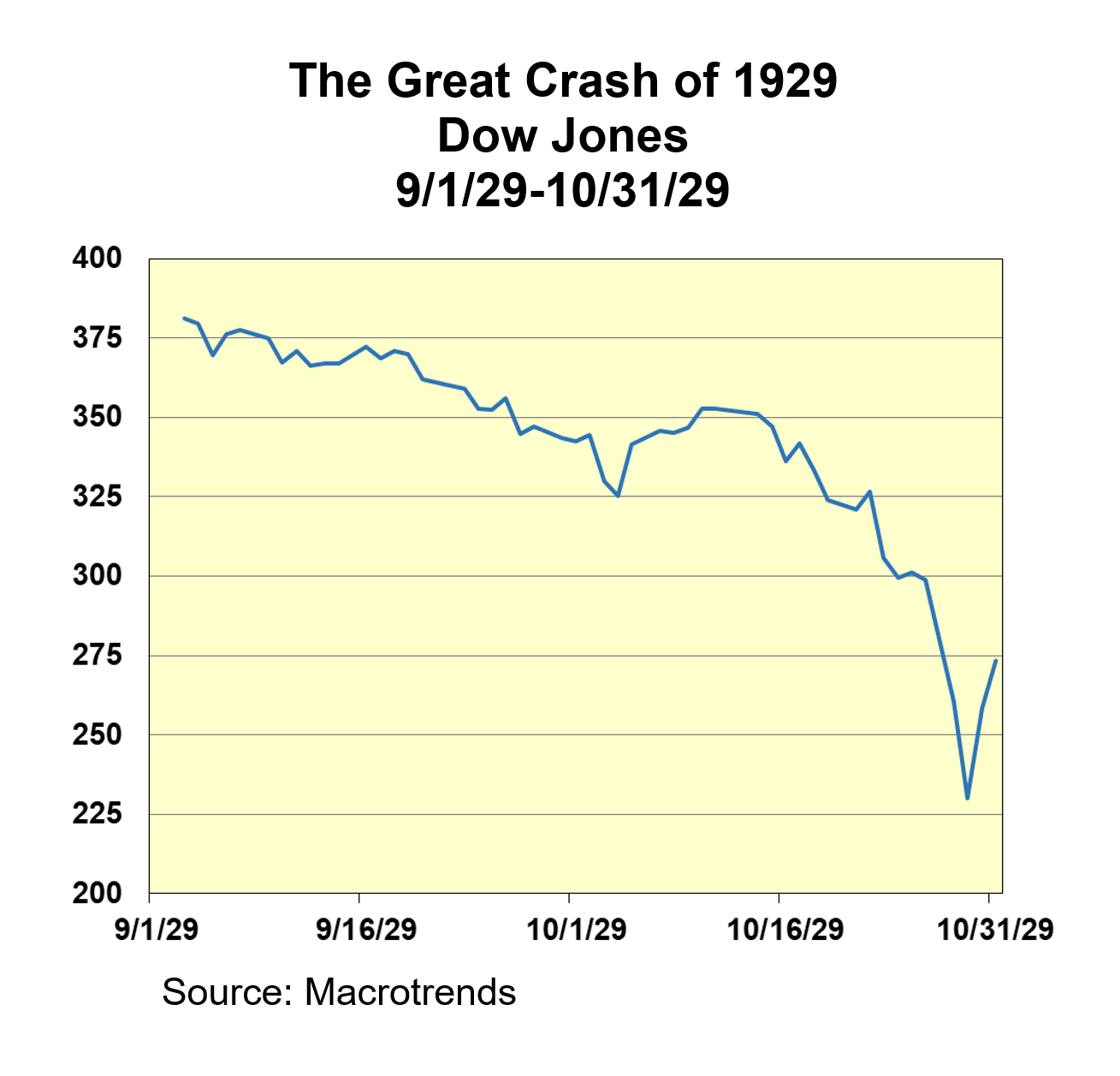
The real panic began on October 28 ‒ “Black Monday.” There was huge volume ‒ over 9 million shares traded. The losses were severe, and prices did not recover later in the day. The Dow was down ‑12.8% on Black Monday. The following day, “Black Tuesday” was equally bad; 16 million shares changed hands, and the Dow ended down -11.7%. The stock market had plunged 23% in two days; it declined approximately 30% during the month of October 1929. Yet the Dow was down only 17.2% during 1929, which hardly seems a recipe for the Depression which followed. In fact, the Dow rebounded 27% from the close of business on Black Tuesday, October 29, to the last day of April 1930, when the Dow finished at 294 ‒ up from 230 on October 29, 1929. The chart below shows the stock market’s action during the Crash of 1929:
Sorkin devotes ten pages in the preface of 1929 to listing the cast of characters who played important roles in the Crash. There is neither time nor space to describe them all and their actions in the drama. But we should mention several of the most interesting players. First and foremost, Jesse Livermore. We have written several times about the legendary Jesse Livermore, who in his early years was nicknamed
“The Boy Plunger.” In the 1929 run-up in the stock market to the Great Crash, Livermore primed himself to take major short positions in the stock market, as he judged the market to be greatly overvalued. When Livermore was driven by his chauffeur to his grand estate on Long Island on Black Thursday, he was startled upon entering his home to find that several paintings, Persian rugs, and antiques were missing. Then he opened his safe and discovered that his wife’s gems, worth millions, were gone. He called out for his wife, Dorothy, and his children. No answer. When he went to the kitchen and asked the staff where his wife and boys were, he was told, “They have moved into the chauffeur’s apartment. We have all heard about the great crash. We are very sorry, Mr. Livermore.” Above the garage, he found his wife perched on a couch surrounded by their belongings. When asked what she was doing, his wife tearfully told him she was distraught that the market had caused them to go broke, and she was trying to protect their belongings from creditors. She remembered that he had pawned some of her jewels in the past when he needed to raise a stake. He smiled and reassured her: “Today was the best day I ever had in the market.” During the crash, Livermore’s profits amounted to $100 million. Unfortunately, Livermore’s luck did not hold in the 1930s, and he took his own life in the bathroom of the Sherry-Netherland hotel in 1939.
Sorkin also recounts how Bernard Baruch covered some of Winston Churchill’s speculative losses. It turns out that Churchill was a dreadful investor. According to his personal secretary, Jock Colville, Churchill viewed the stock market like the casino at Monte Carlo; it was all luck. He came to America in October 1929 and opened a brokerage account. Baruch, his great friend and benefactor, helped to cover his trading losses with a gift of $7,200. However, this fell well short of the amount needed to cover Churchill’s losses, which amounted to $75,000, and wiped out all of his book royalties and brought him close to bankruptcy.
One of the characters at the center of the drama of the great crash was Charles E. Mitchell, chairman of the board of National City Bank. Sorkin appropriately devotes a great deal of ink to Mitchell’s role in the crash of 1929. Born in Chelsea, Massachusetts, Mitchell graduated from Amherst College in 1899 and worked initially with Western Electric Company. In 1907, he moved to New York where he became assistant to the president of Trust Company of America. Marrying Elizabeth Rend, the daughter of a coal magnate, in 1908, “Sunshine Charley,” as he became known, founded his own investment bank, C.E. Mitchell & Company in 1911. Then he joined National City Bank (now Citibank), becoming its president, as well as president of National City Company, which became one of the largest issuers of securities in the world. He was known for his relentless push to sell securities (largely bonds) to investors throughout the U.S. as well as shares in the bank to clients and employees alike. Under his leadership, the bank had 100 branches in 23 countries, becoming one of the largest banks in the world. In January 1929, Mitchell had joined the New York Federal Reserve Bank as a director largely due to the influence of Benjamin Strong, who had served as governor of the New York Fed from 1914 until his death in 1928. Not being a team player, Mitchell, as discussed above, directed his bank in March 1929 to make $25 million in loans available to brokers in need of liquidity ‒ acting in opposition to the Fed which was trying to curtail speculation. Aside from his role in seeking to halt the October panic in the market, Mitchell became known for his indictment and arrest in 1933 for tax evasion, when he sold shares to his wife, realizing a large capital loss to minimize his tax liabilities. He was eventually acquitted but had to pay nearly $1 million in a civil settlement to the government. Mitchell’s chief enemy in the 1930s was Senator Carter Glass (sponsor of the Glass-Steagall Act of 1933) who saw Mitchell as one of the main villains of the great crash.
Why Did the Stock Market Continue to Plunge in 1930-1932?
From the top of the bear market rally in 1930, when the Dow Jones reached 294, it descended to 40.6 on July 8, 1932. The chart below shows the extraordinary damage done to stock prices during this three-year period:
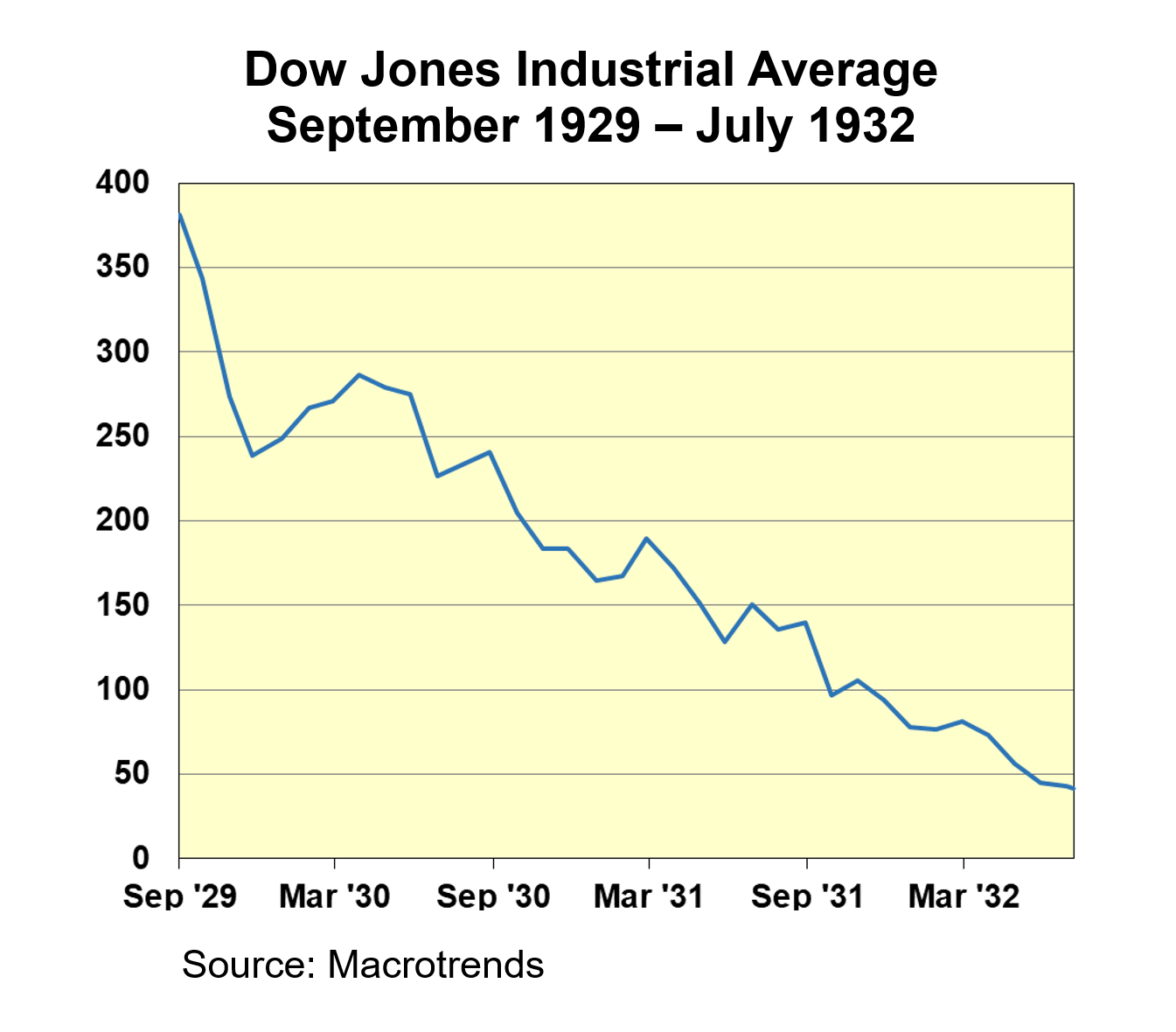
From its peak in September 1929, the Dow fell 89.2% to the bottom in July 1932. The popular narrative is that the Crash of 1929 caused the Great Depression. And the Depression was, indeed, a terrible economic catastrophe. In the U.S., GDP dropped by approximately 35%. In contrast, during the so‑called Great Recession of 2007-2009, U.S. GDP dropped by 4.3%. Unemployment reached 25% in 1933, and despite the many initiatives taken by FDR during the New Deal, unemployment was still 19% in mid-1938. But if the great Crash of 1929 did not cause the Great Depression, what were the factors that did?
There are many theories about the causes of the worldwide Depression that gripped the global economy between 1930 and 1941, but most economists and historians agree the following were the main factors:
- Instead of being the “lender of last resort,” injecting massive liquidity into the financial system (as in the Crash of 1987 and the Financial Panic of 2008), the Federal Reserve Bank contracted the money supply by approximately one-third in 1929- This was in the face of over 5,000 banks that failed in this period.
- Despite the roughly 1,000 economists who petitioned President Hoover to veto the Smoot-Hawley tariff, he signed it in 1930, raising U.S. import duties on over 20,000 goods. This triggered retaliation by other nations, causing a global trade war, which diminished global trade by over 60%.
- Both Presidents Hoover and Roosevelt held to a strict policy of balancing the federal budget rather than fiscal expansion through deficit spending, although circumstances caused them both to run deficits.
- Loss of faith in capitalism and the U.S economy caused consumers to spend less and companies to invest less in productive capacity, resulting in severe economic contraction.
Is a Stock Market Crash on the Horizon in 2026?
As Yogi Berra purportedly said, “It is dangerous to make predictions, especially about the future.” Following in his footsteps, we are wary about forecasting the future of the stock market over the near term, as with this market (and most markets), anything is possible if panic takes hold. Some of us are old enough to remember the day, Monday, October 19, 1987, when the S&P 500 Index dropped 20.5%. When the “internet bubble” burst in 2000, the NASDAQ Composite plunged 78% from early 2000 through October 2002. From October 2007, when the S&P 500 peaked at 1565, it fell to an intraday low of 666 in March 2009 during the Great Financial Panic ‒ a decline of 57%. International markets fared worse. These things happen from time to time.
None of these dramatic sell-offs resulted in a depression, and even the so-called Great Recession of 2009 caused less damage to the economy than the period in 1980-1982 when Federal Reserve chairman Paul Volcker raised the fed funds rate to 20% in an effort to tame runaway inflation. During the years since the Great Depression, the U.S. government and key institutions have learned a great deal from the past. For example, the U.S. government enacted FDIC deposit insurance so that depositors would not lose everything if their bank failed, as in the Great Depression. The U.S. stock market became regulated by the Securities and Exchange Commission which prevented insider trading and operator pools. Margin lending was more carefully regulated: speculators can no longer buy stocks with only 10% down. Most importantly, the Federal Reserve Bank now understands that in times of panic, as we will surely see at some point again in the future, their role is to expand the money supply and be the “lender of last resort,” so that banks like Mitchell’s National City Bank in 1929 or J.P. Morgan in 1907 do not have to assume this role.
Unquestionably, there is currently much speculation in the stock market, much of it by retail investors. Margin debt has increased roughly 50% during the past year to $1.4 trillion, but it nevertheless represents only about 2% of total U.S. stock market capitalization. There are now over 400 single stock ETFs in the U.S., many using leverage. This is a worrisome sign. And, young investors have never experienced a dramatic bear market akin to those in 2000-2002 and 2007-2009. How will they behave in a stomach-wrenching bear market? Moreover, the stock market is currently richly valued with P/E ratios well above the long-term averages. All signs for caution. On the other hand, the economy is showing moderate growth with corporate earnings growing robustly. Profit margins are wide and steady. But, all in all, it is an unhealthy market, with the advance led by a small number of high-performing stocks concentrated in the Artificial Intelligence trade. And this will come to an end at some point. This leaves us at BFS with a clear measure of caution about the stock market. Accordingly, we do not subscribe to Professor Fisher’s prediction in 1929: “Stock prices have reached what appears to be a permanently high plateau.”
In summary, while we see the Crash of 1929 as a cautionary tale, we don’t believe that a dramatic market sell-off, which is always possible in this world of geopolitical and economic volatility, would lead to the economic catastrophe of the 1930s. Thankfully, governments and central banks have enough arrows in their quivers to prevent a disaster of this magnitude.
Rob serves as chairman of Bradley, Foster & Sargent. He is a portfolio manager and member of the firm’s investment committee and its board of directors.
Rob founded Bradley, Foster & Sargent with Joseph D. Sargent and Timothy H. Foster. Earlier, he was president and CEO of Boston Private Bank & Trust Company, which he founded in 1985, and he spent 14 years with Citicorp, including 12 years in Europe, the Middle East, and Africa. Previously, he served as an officer in the U.S. Navy in Vietnam.
Rob served for seven years on the board of governors of the Investment Adviser Association, the national not-for-profit association founded in 1937 that exclusively represents the interests of federally registered investment advisory firms.
The Crash of 1929
Where is the Stock Market Headed in 2026?
Nvidia’s Jensen Huang: The Ultimate Entrepreneur
Bill Gates and the Story of Microsoft
The Bull Market Climbs a Wall of Worry
A Painful Bear Market
Inflation: 40 Years Ago and Now
Subscribe For More Articles On
Get the latest trends and thought leadership to help you make smarter financial decisions.