“Gamifying” Capital Markets & What it Reveals About it’s Users…
The US equities markets have created an abundance of wealth over the course of the past century while serving as the poster child of American prosperity. The value proposition was simple: buy and hold and you will be rewarded. Yet, in the era of high-flying AI and other growth trends continuing to propel equities higher, why do younger generations appear more uninterested in the traditional path than ever?
Over the past 40 years capital markets have become exponentially more democratized as the cost of trading continues to converge toward $0 and most full-time employers offer defined contribution plans promoting participation. A byproduct of this has been the proliferation of various other financial products to fill the gaps which traditional vehicles did not address. More recently we have seen a unique acceleration in alternative products which look to blur the lines between investing and speculation.
Examples include:
- 0DTE Options
- Highly-levered ETF’s
- Prediction Markets (Kalshi and Polymarket just recorded $10B in volumes for November ALONE vs virtually $0 in 2020…)
In reality, the type of product is largely irrelevant to this discussion, since these all serve near-identical underlying functions– timeline compression and instant gratification.
As one might expect, this sales pitch resonates particularly well with younger generations as the opportunity to “get rich quick” provides this cohort with a false sense of agency. 76% of all new betting activity growth is from Gen Z and millennial accounts (per TransUnion). Older generations who compounded wealth through traditional routes such as 401k plans, house appreciation, pensions, and various other productive financial assets find these behaviors difficult to rationalize. These perspectives are often presented at odds with each other, but unbeknown to many are both driven by same internal motivation for a sense of agency and the feeling of climbing the economic ladder.
Younger generations are exhibiting a well-understood behavioral economic concept called convex utility of losses. This theory argues those who feel who they are already losing prefer a small chance of getting “even” rather than a certain moderate loss. But why do younger generations and lower income cohorts feel disadvantaged?
The K-shaped economy is a theme which will find itself under heightened scrutiny come midterm elections this fall. The phenomenon looks to describe the widening dispersion of higher income Americans who source the majority of their wealth from asset appreciation, and lower income Americans who source their wealth from wages. The graph below from Strategas attempts to quantify these dynamics using the S&P 500 (asset owners) & consumer confidence (wage-earners) data as proxies:
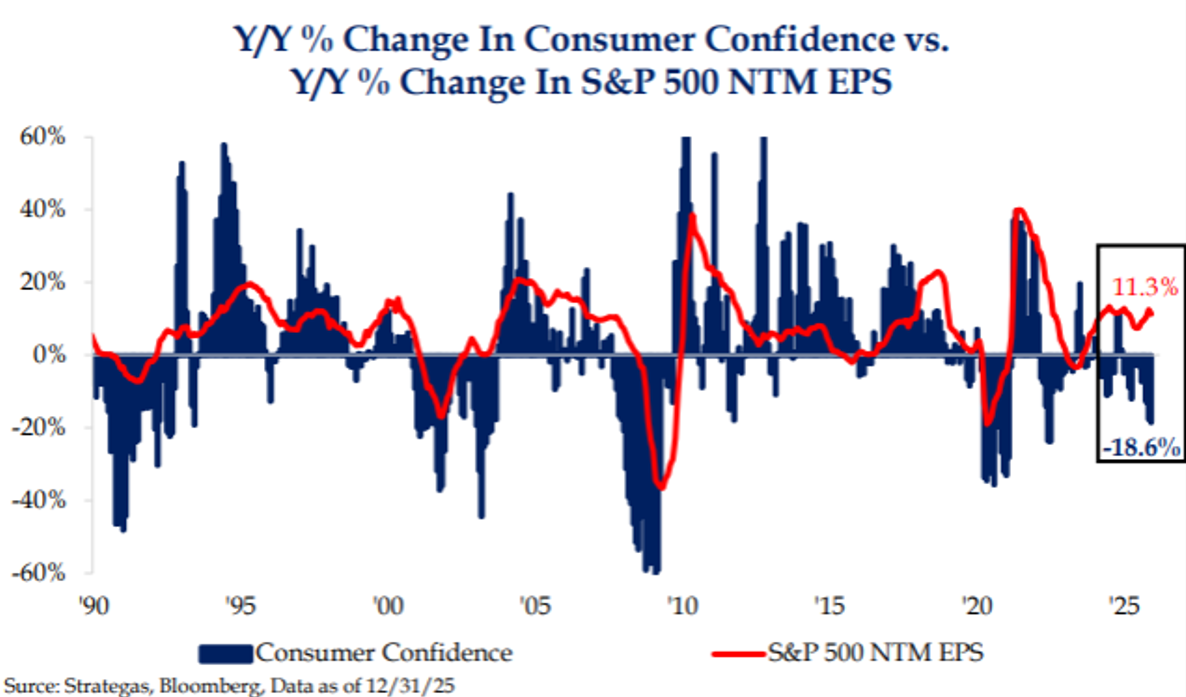
It seems counterintuitive for corporate earning power to continue to appreciate without American prosperity growing proportionately alongside it, but the main culprit of these dynamics is inflation. Controlled inflation is a healthy environment for risk assets as it serves as a tailwind for pricing growth and therefore sustains earnings power. However, as Evercore shows below, real wage growth- which represents salary appreciation above inflation– has been negative for lower income cohorts.
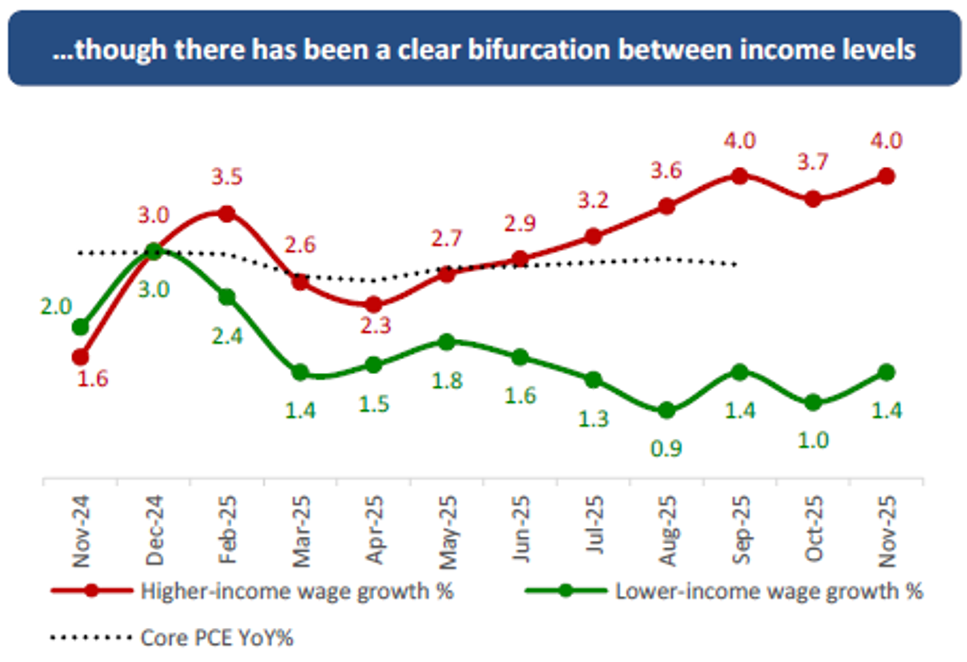
Simply put, asset-owners win while wage-earners lose on a real return basis. If wage earners feel like their current situation is depriving them of agency and obtaining the American Dream, they will naturally be inclined to push out farther on the risk curve.
Brokers, prediction markets, and gambling operators all understand and leverage this dynamic in both their product offerings and UI design.
The rise of 0DTE options is a perfect reflection of this as they allow users to express their conviction on a particular security in hours rather than months. These products exploded in popularity post-COVID and now represent over 60% of all SPX options volume (per CBOE). A 0DTE option is now more accessible than ever and UI surrounding these features are purposely designed to be “content-friendly” incentivizing users to share screenshots of gains (and ignore steep losses) which fuels the underlying flywheel. Pair this with social media algorithms which are designed to amplify wins and spark a sense of FOMO to those not already participating, and you can begin to see where these issues arise.
Leveraged ETF’s also promotes short-term trading as its design inherently creates volatility decay and therefore tracking error that drives higher turnover. Sports betting incorporates a house edge (often called the “vig” or “juice”) that ensures the mathematical payout is always lower than the total wager in the long term. You can hopefully spot some recurring themes here.
How do you win in todays markets?
The truth is that counterproductive products have always existed throughout capital markets and will almost certainly never be eliminated (they just change form). Wealth creation is the function of participating in games with positive expected value over long horizons and benefiting from the wonders of geometric compounding. Unfortunately many societal pressures today run counterintuitive to this thought process and the need for constant stimuli pushes many towards behavioral irrationality.
However, we believe this environment rewards patient investors whose decisions are based on the core fundamentals behind the securities within their portfolios. Positive expected value is difficult to achieve sustainably in the short term because price action can often deviate temporarily from business fundamentals and is susceptible to random noise. In the longer term, however, asset prices tend to converge with their fundamentals, which are derived from their earnings power and perceived business quality.
As long as humans participate in the capital market system, there are bound to be mispricings that present themselves. Disciplined investors who can look at fundamentals objectively and sort out the noise of markets will be best positioned to sail the waters of the next decade.
As an equity analyst, Colin is responsible for company, industry and stock analysis, in understanding competitive advantage, drivers of business, financial analysis, and valuation in order to develop robust recommendations in support of the firm’s investment of clients’ assets.
What’s Going On With Interest Rates?
SpaceX IPO: Looking Beyond the Hype
The Fog of War
Pei-ju Lee quoted in Quartz article on AI boom
Why Market Cap Matters for Diversification
One Big Beautiful Bill: A Summary
Turning Savings Into a Financial Plan
New Year, Same Goals? A Financial Check-In
Laying the Groundwork for Financial Freedom
A Look at Cybersecurity in a Changing World
How to Create Wealth in Your Retirement Accounts
Investing in 2024: Pros and Cons of Modern Strategies
Gold is Moving, Time for the Miners
Gold Ascending
A Cautious Look into the Future
Private Finance – Opacity Is Not a Virtue
Finding Your Tax Equilibrium
The Limits of Largesse
Demystifying Secure Act 2.0
A Suggestive Failure of Market Confidence
Fed Up?
Housing: A Little Too Frenzied?
Thoughts on Bitcoin and Cryptocurrencies
Gold: A Case of Excessive Pessimism
The Fed’s Freedom to Tighten is a Paper Tiger
ESG Epiphany
Investing with Keynes
Cash Flow Reigns King
Euthanasia of the Lender
Subscribe For More Articles On
Get the latest trends and thought leadership to help you make smarter financial decisions.