The Most Powerful Force in Investing Makes No Noise at All
“What the pupil must learn, if he learns anything at all, is that the world will do most of the work for you, provided you cooperate with it by identifying how it really works and aligning with those realities. If we do not let the world teach us, it teaches us a lesson.”
– Joe Tussman
Successful investors find unrecognized simplicities buried inside a world that rewards looking complicated. Economies are flooded with a mosaic of oftentimes conflicting signals that consistently confuse even some of the smartest academic professionals on the planet. Funny enough, the prosperity of the United States as a nation over the past century can be perfectly captured through just ONE measurement: growth in real GDP per captia.
Productivity, The Silent Compounder That Has Never Let America Down…
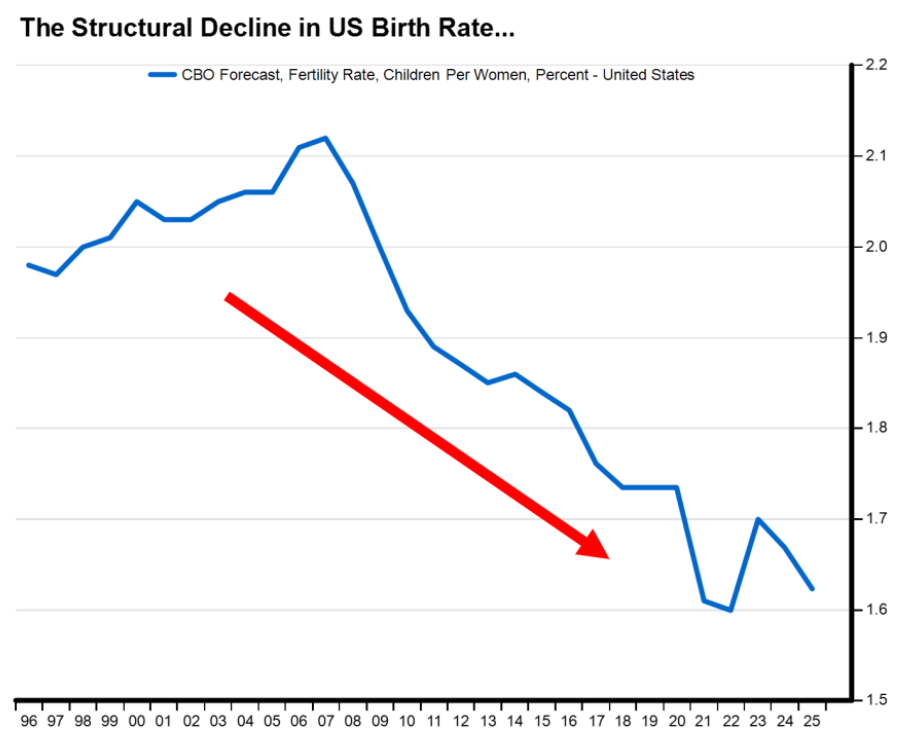
The future of American society has and continues to remain contingent on whether we can continue to squeeze productivity out of our existing workforce. With fertility rates declining across the globe and therefore the labor pool shrinking (see below), the marginal product of labor becomes increasingly more important to American exceptionalism. Productivity is no longer a nice to have feature to the equation, it’s the ONLY variable that can fill the gap.
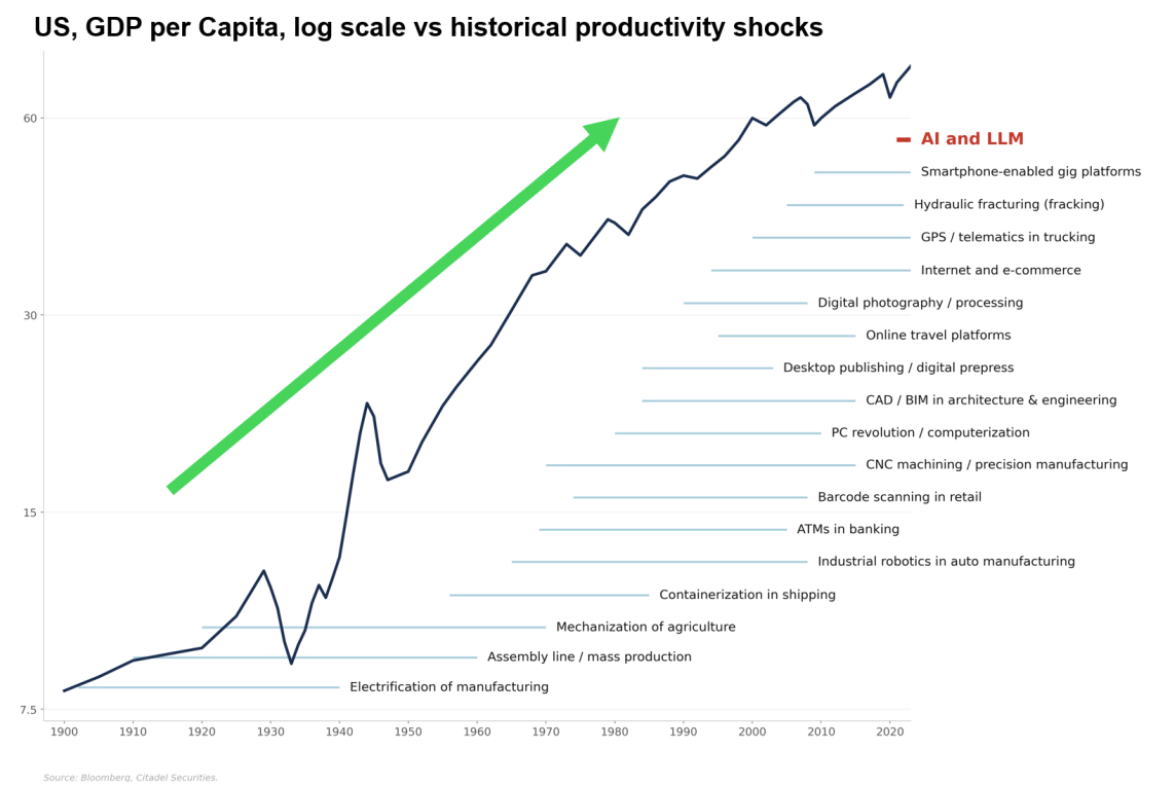
The United States has been uniquely blessed with multiple iterations of technological innovation that has kept real GDP per capita above 2% for nearly 125 years now (see below). Railroads, electrification, the internet, mobile phones – every societal advancement has contributed to solving the most important question in the world, how can we do more with less? AI is either the next wave in this sequence or the variable that ends up breaking it. History clearly suggests the former, but the margin of error has never been tighter.
Media Says Fear, The Tape Says Otherwise.
Oftentimes financial media and narratives can get disconnected from reality. This is by design – engagement drives revenue, not accuracy. The cleanest antidote is prices. Markets aggregate the collective judgement of people with capital at risk, which is a far more reliable signal than any headline. Nonetheless, the gap between consumers gloomy perception of the “future” vs the markets pricing of prosperity has never been wider. Eventually these jaws will close, the only question is when and in which direction:

Can AI replicate these same successes?
The American Society of Civil Engineers estimates that every $1B in infrastructure investment creates 13,000 jobs and adds $3B in GDP over a decade. If you assume the United States invests $1.8T by 2030, this could increase GDP by $5T in 10yrs (or $300B annually)! The math, even discounted heavily, makes its case. The bottleneck feels more around adoption than it is about capital…
The sentiment around AI has dramatically deteriorated and adoption has been met with extreme resistance. Why should Americans actively work to implement models that eventually can do their exact function at the fraction of the cost? Isn’t this self-cannibalization?
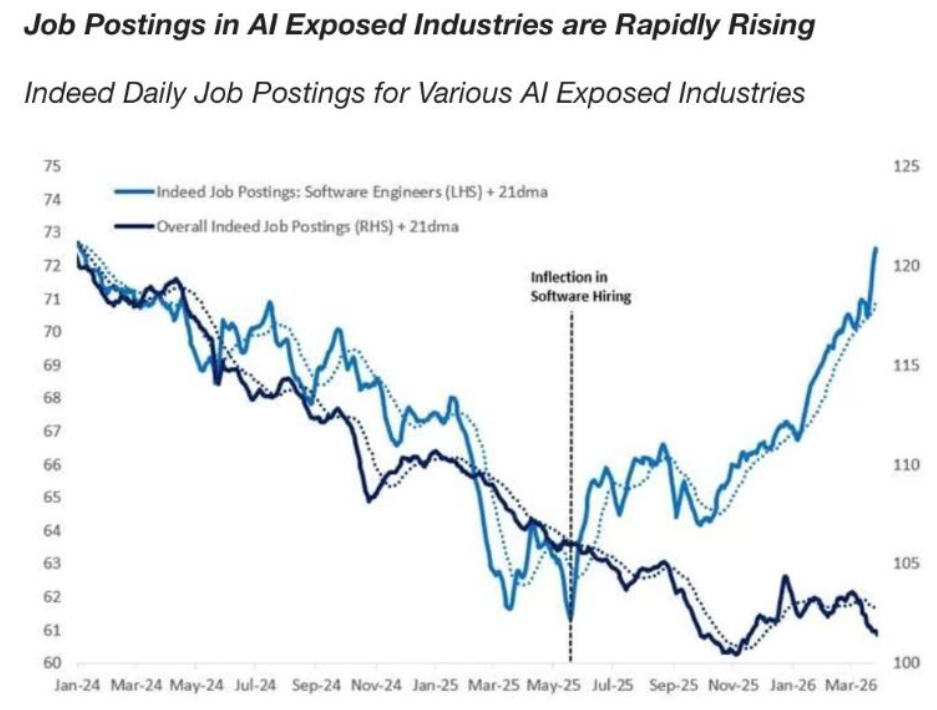
It’s a fair concern, but it all goes back to the 8th wonder of the world, productivity. Early reads on AI have shown that it expands the demand for intelligence faster than the cost to supply it. This would indicate a step-function increase in the amount of output businesses can produce per unit of labor. Software, which is supposed to be the most immediate AI-exposed category, has seen job postings UP – not just in relative terms but also in absolute as well:
This is not intended to be dismissive of deep structural issues of G7 economies – exactly quite the opposite. Every dollar added to our growing deficit, every trillion committed to infrastructure the world hasn’t yet learned to use, every basis point the long end demands to believe it — raises the stakes on the promise of an AI-led growth acceleration.
Productivity never needed permission, never made headlines, and investors have consistently been paid to bank on it. It’s the silent force behind American exceptionalism, and for the first time it has a technology powerful enough to extend that trend into a future where the workforce alone cannot. The world is doing most of the work, Tussman warns about the risk of refusing to cooperate with it.
As an equity analyst, Colin is responsible for company, industry and stock analysis, in understanding competitive advantage, drivers of business, financial analysis, and valuation in order to develop robust recommendations in support of the firm’s investment of clients’ assets.
What’s Going On With Interest Rates?
SpaceX IPO: Looking Beyond the Hype
The Fog of War
People First. Then Technology
Pei-ju Lee quoted in Quartz article on AI boom
Why Market Cap Matters for Diversification
One Big Beautiful Bill: A Summary
Turning Savings Into a Financial Plan
New Year, Same Goals? A Financial Check-In
Laying the Groundwork for Financial Freedom
A Look at Cybersecurity in a Changing World
How to Create Wealth in Your Retirement Accounts
Investing in 2024: Pros and Cons of Modern Strategies
Gold is Moving, Time for the Miners
Gold Ascending
A Cautious Look into the Future
Private Finance – Opacity Is Not a Virtue
Finding Your Tax Equilibrium
The Limits of Largesse
Demystifying Secure Act 2.0
A Suggestive Failure of Market Confidence
Fed Up?
Housing: A Little Too Frenzied?
Thoughts on Bitcoin and Cryptocurrencies
Gold: A Case of Excessive Pessimism
The Fed’s Freedom to Tighten is a Paper Tiger
ESG Epiphany
Investing with Keynes
Cash Flow Reigns King
Euthanasia of the Lender
Subscribe For More Articles On
Get the latest trends and thought leadership to help you make smarter financial decisions.