The Artificial Intelligence Trade
Some people call this artificial intelligence, but the reality is this technology will enhance us. So, instead of artificial intelligence, I think we’ll augment our intelligence.
Ginni Rometty, Former Chairman, President & CEO of IBM
Many barrels of ink have been spilled over the past several years on Artificial Intelligence (AI). Most recently, there has been a robust public policy debate about the dangers of AI. Some in the industry have predicted that AI will end human existence within a few years. At the same time, there has been a growing movement in various states throughout the U.S. to ban the building of data centers — the engine rooms for producing AI — in their communities. The purpose of this investment commentary is not to wade into these public policy debates. Instead, this essay is written to provide a high-level view of the AI trade, describing what AI is, the key players in the AI industry, and the investment implications for those companies in the AI and AI-related industries. As discussed below, the boom in capital expenditures in AI is the largest one in American history. Seeking to provide a brief summary of this topic is like drinking from a fire hose, but we will do our best to reduce this subject to its most basic and important elements.
Three years ago, we wrote a primer on AI. Not wishing to rehash all the themes of that essay, we nevertheless believe that it is helpful to restate the basic narrative of the origins of AI and its development over the recent past. The British mathematician, Alan Turing, who helped crack the German Enigma code during World War II, introduced many of the key concepts of AI in a paper written in 1948 entitled “Intelligent Machinery.” In it, he proposed the “imitation game,” which became known as the Turing Test, to measure whether a machine can exhibit human-like intelligence. Some years later, a summer workshop was organized in 1956 by John McCarthy at Dartmouth College when researchers, working on machine intelligence, coined the term “artificial intelligence.” Over the decades that followed, the most important step forward was the development of early transformer models that have neural networks that learn context and thus meaning by tracking relationships in sequential data such as the words in this sentence. In 1997, IBM’s supercomputer famously defeated world chess champion Garry Kasparov — a major step forward for machine intelligence squaring off against human intelligence. Then came the popular virtual assistants. In 2011, Siri was introduced by Apple. Amazon’s Alexa came several years later in 2014. In 2015, OpenAI, the owner of ChatGPT, was founded with a $1 billion commitment from investors Sam Altman, Elon Musk, Reid Hoffman, Peter Thiel, and Amazon Web Services (AWS), among others. Two years later, a Google research paper introduced Transformer architecture, the underlying architecture for Large Language Models (LLMs) which empower generative AI. Between 2019 and 2023, Microsoft invested $13 billion in OpenAI, accumulating a 49% stake in the company. In November 2022, OpenAI released ChatGPT. Since then, there has been an explosion of competing AI products like Gemini (Google, whose parent is Alphabet), Claude (Anthropic), Muse (Meta Platforms), Grok (Elon Musk’s xAI), and Copilot (Microsoft).
So, what exactly is AI? In the simplest terms, AI is the imitation of human intelligence by machines. AI covers a wide range of technologies and systems which perform complex actions that historically required human cognition, such as reasoning, problem-solving, learning, perception, and decision-making. There are two types of AI: traditional AI (or computational AI) and generative AI. Traditional AI is typically a rules-based computation that, through the use of algorithms such as machine learning, can learn from historical data and make predictive decisions based on the patterns that it has learned. You can recognize this form of AI when you begin to write a phrase or a sentence in Microsoft Word or similar programs, and the computer completes it for you. Or when you are writing an email or a letter and misspell a word, this kind of AI corrects your spelling. Or perhaps you type a question into a search engine, and the correct answer is immediately available. Another use is when someone uses your credit card in a faraway location, and the credit card company rejects it as potential fraud.
Generative AI is characterized by Large Language Models (LLMs), neural networks of algorithms that can recognize, summarize, translate, predict, and generate text and other forms. Unlike traditional AI, which is designed to recognize patterns and make predictions, Generative AI creates new content in the form of images, sentences, paragraphs, text, and audio. An LLM is typically trained on massive datasets. The input can be proprietary corporate data or, as in the case of ChatGPT, whatever data can be found on the internet. Frequently, the text fed into the model is unlabeled or uncategorized. This can lead to problems if the text is incorrect or propaganda.
Training LLMs requires the use of massive, expensive server farms (data centers) that act as supercomputers. The evolution has been fast. Compared to the three-year-old GPT-3 model featuring 175 billion parameters, the latest models have between 2.8 and 8 trillion parameters to help them decide between different answer choices. As complexity increases, training LLMs becomes more resource-intensive.
With Generative AI, humans can easily communicate with computers, orally or in text, in their native language rather than in programming language. Unless you are a computer scientist, this may not be entirely clear, but the following applications may be helpful:
- ChatGPT, Gemini, Grok, and other AI applications respond to questions and compose written content including essays, articles, and social media posts.
- AI programs allow creators to generate images based on descriptive texts. Adobe’s Firefly is a good example of this.
- ChatGPT took the legal Uniform Bar Exam in 2022 and passed the exam with a score that approached the 90th percentile of test takers.
- ChatGPT passed the CPA exam with an average score of 85.1%, according to researchers at four universities.
Closed Source and Open Source AI Models
Some AI models are closed source, which means that the company keeps their code, weights, and training data private. Examples of companies whose models are closed source are: OpenAI’s GPT series, Anthropic’s Claude, and Google’s Gemini. Open source models make their files or data available for public download and local use. Meta Platforms and DeepSeek, a Chinese AI company, are examples of open source models which can be downloaded and customized by users. Currently, there is a great debate about which model is more dangerous to humanity — whether it is huge, sophisticated, closed source “frontier” models which are uncontrolled by regulations of any kind, or open-source models that can be released to the public and cannot be pulled back or patched if exploited by malicious actors. Bad actors can strip away safety guardrails, fine-tune models for cyberattacks or biological threats, and distribute them freely without oversight. A vigorous debate is currently underway about this subject regarding the necessity for national or international regulatory bodies to supervise AI players. The debate will also deal with a company’s liability if and when its AI agents escape the control of its supervisors at the company and hack or cause damage, as in the recent case of OpenAI agents swarming and hacking into Hugging Face.
AI Capital Expenditures in the U.S.
Over the past several centuries, there have been six major capital expenditure booms in the U.S. In the 19th century, the two major booms were the building of canals before the Civil War and then railroads in the several decades following the Civil War. The 20th century saw three major capital expenditure booms: the electrification of the country, the building of the national highway system, and the telecom/fiber and internet boom. Currently there is an AI boom. The chart below shows that capital expenditures in the AI boom as a percentage of GDP will probably be greater than any of the previous booms:
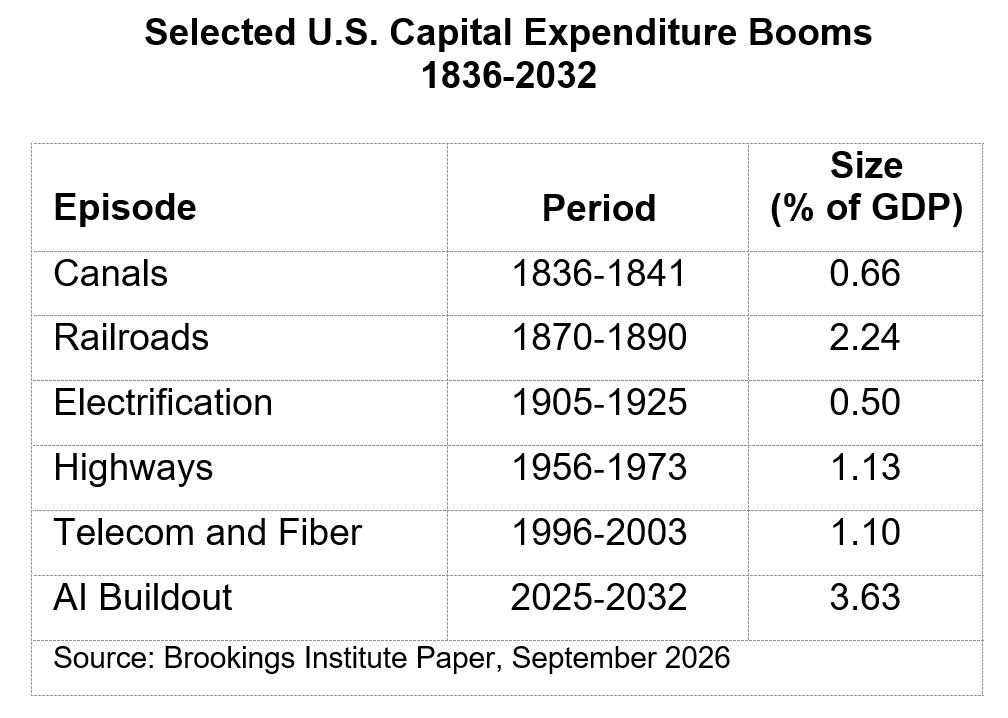
The Capital Expenditure Boom
These enormous capital expenditures emanate from a handful of so-called hyperscalers. A hyperscaler is a company that operates globally-distributed networks of data centers to provide cloud computing, storage, and networking services at an enormous scale. Leading hyperscalers include: Amazon, Microsoft, Alphabet (Google), Meta Platforms (Facebook and Instagram), Oracle, IBM, and Alibaba. Interestingly, AI did not develop because of enormous consumer and corporate demand for products and services. The demand developed in the same way that Steve Jobs, CEO at Apple, sparked enormous demand for the iPhone, a device consumers did not yet know they needed. Although consumers could barely envision what an iPhone was and could do, he effectively created demand for it through the development of a revolutionary multi-touch product and brilliant marketing. In much the same way, the hyperscalers have created great demand for AI products and services which the public was not clamoring for but has found increasingly useful.
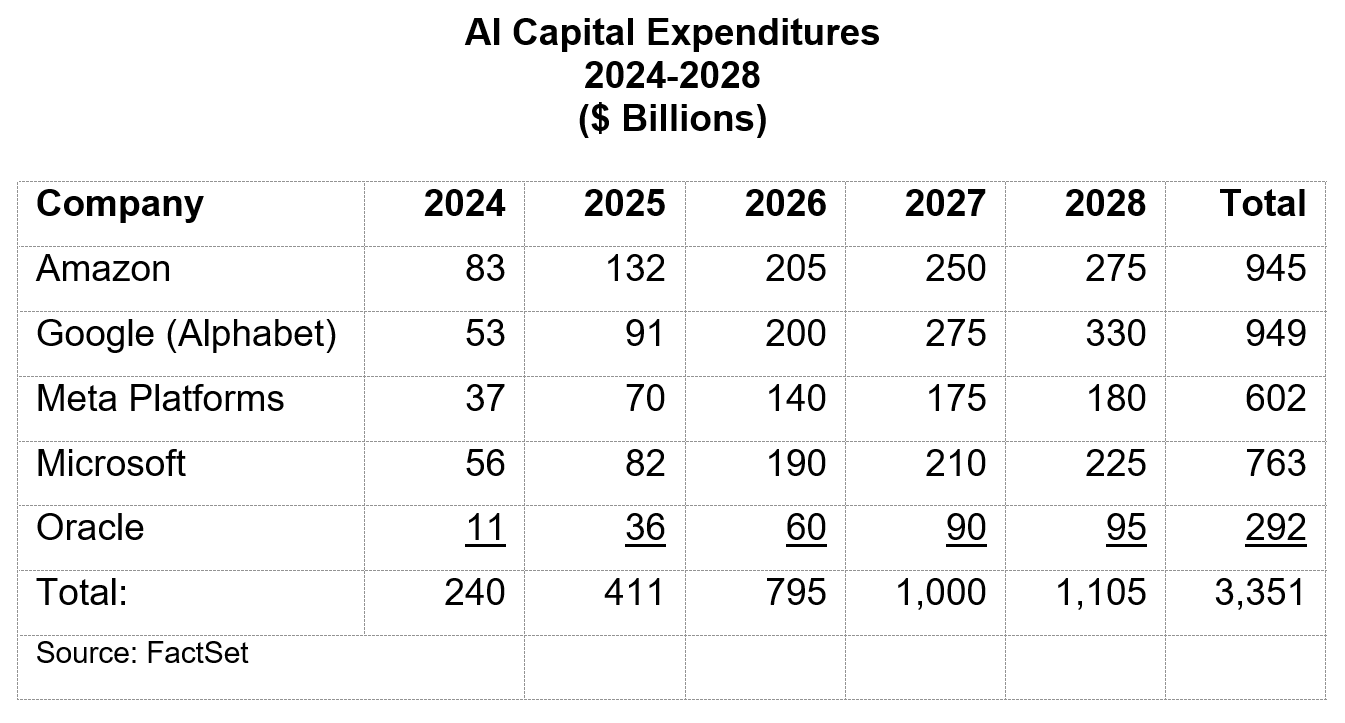
The table below shows the amount of money that the leading hyperscalers have spent or are projected to spend on AI capital expenditures in the five-year period commencing in 2024:
Where is the Money Coming from to Finance These Capital Expenditures?
In 2025, these five companies generated more than $600 billion in aggregate in operating cash flow. The only one of these companies with less than $100 billion in operating cash flow was Oracle, which produced only $22 billion. Each of the other four produced well in excess of $100 billion in operating cash flow. The $600 billion in operating cash flow from these five companies more than adequately covered the $411 billion in capital expenditures in 2025, but the gigantic growth in capital expenditures in 2026 and then forecasted for 2027 and 2028 will not be covered by cash flow. This means that these hyperscalers have had to go to the capital markets to raise the necessary capital to execute their plans. Each of these five companies has raised between $20 billion and $100 billion through debt and equity offerings over the recent past. For example, Google raised approximately $100 billion in debt and equity financing over the past 12 months to augment their operating cash flow to deal with financing their AI capital expenditures. In its forthcoming IPO, Anthropic is seeking to raise $100 billion, which would value the company at $2 trillion.
Off-Balance Sheet Financing
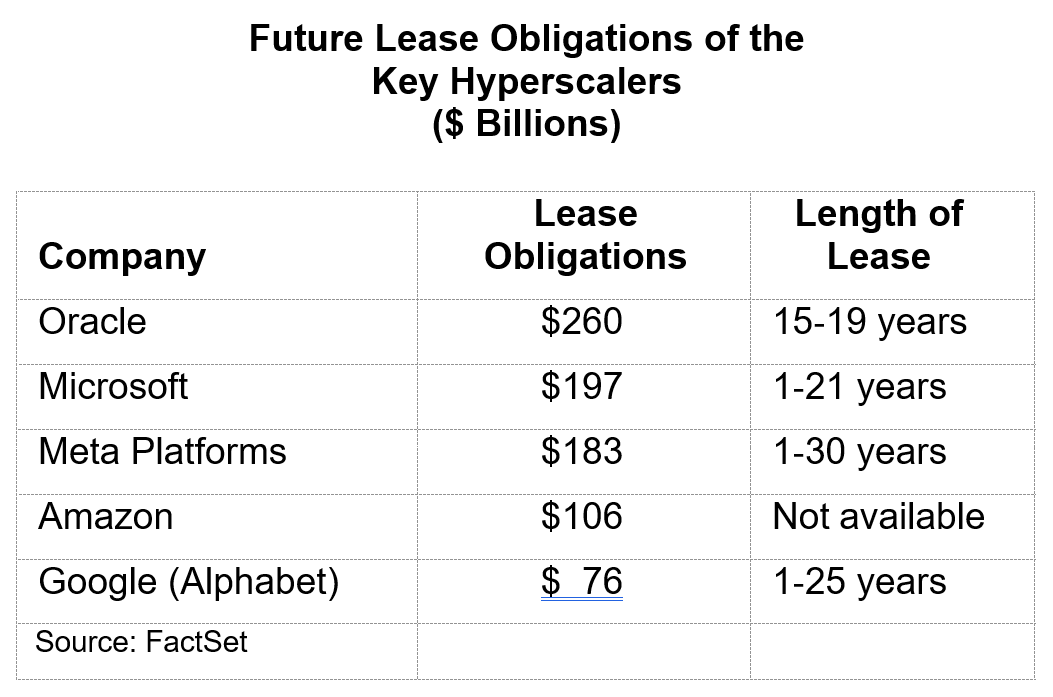
In addition to issuing debt and equity to augment operating cash flow to finance AI capital expenditures, the major hyperscalers have also assumed very significant off-balance sheet obligations to help finance the capital expenditures. The table below displays the future lease obligations to data centers that the five hyperscalers have committed to over the coming years:
Example of How the Financing of a Giant Data Center is Structured
Betting on huge demand for their AI computing, Meta Platforms is moving forward to establish an enormous data center project in Louisiana called “Hyperion.” It is the size of approximately 1,700 football fields and is being financed by a special purpose vehicle (SPV) named Beignet Investor LLC, owned 80% by Blue Owl Capital and 20% by Meta. The total cost is estimated to be around $30 billion, of which $27 billion is financed by debt purchased by firms like PIMCO and BlackRock, and $3 billion in equity from Meta (in addition to the land that was contributed by Meta). For the debt holders to be willing to purchase the bonds, Meta has committed to lease Hyperion for four years, starting in 2029, with options to renew. Additionally, Meta has executed a 16-year residual value guarantee of the project. By structuring the deal in this manner, Meta has been able to keep the liabilities associated with the Hyperion project off its balance sheet. According to a Wall Street Journal analysis, nine leading tech companies currently have $3 trillion of off-balance sheet commitments. These commitments consist of approximately $1.2 trillion in leases to data centers under construction and $1.8 trillion in commitments to purchase electricity, hardware, chips, and other equipment.
Major Suppliers of the Data Centers
In order to create a functioning data center, the hyperscalers need to spend massive amounts of money on processors (semiconductor chips) and memory and storage devices. Additionally, there needs to be electrical connectivity within the data center, networking software, and cooling systems. The data centers devour enormous amounts of electricity from the utilities that produce the power. Accordingly, this generates much business for the construction equipment manufacturers such as Caterpillar, construction companies like Quanta, and power management firms. The following are examples of companies that are deriving significant revenue and earnings from the AI trade:

Uses of AI
Clearly, the first and easiest way for individuals and organizations to use AI is in handling high-volume, repetitive, routine tasks such as data entry, sorting emails, processing invoices, and routine IT troubleshooting. Another use is enhancing productivity by writing software codes, drafting marketing copy, and summarizing lengthy reports. AI can help write letters, draft documents, and aid communication in various ways. Many companies are already using AI to screen resumes and assist in hiring talent, with AI agents participating in interviews. But even more important will be AI helping to generate more revenue growth by creating new drugs for biotech and pharmaceutical companies, stimulating consumer demand, and coming up with new technological products.
Monetizing AI Capital Expenditures
There are numerous ways in which AI generates revenues. The most obvious example is the hyperscalers such as Meta Platforms and Alphabet, which are positioned at the intersection of infrastructure and applications. They are already monetizing indirectly through higher cloud demand. For example, Instagram, with its amazing AI algorithms, creates more user interface which drives greater ad revenue. When a consumer performs a search on Google, the answer comes back from Gemini which draws more traffic to their site, creating greater ad revenue. Additionally, the hyperscalers rent out their computing systems which brings in significant revenues. According to a JP Morgan study, roughly 55% of Americans now use GenAI like ChatGPT weekly leading to widespread adoption, which creates revenue. ChatGPT is free for basic users, but heavy power users and heavy researchers pay $100-200 per month. Perplexity, a favorite GenAI site, uses other firms’ LLMs, charging $20 per month for frequent users. Heavy users of AI pay for access to major application firms like Open AI, Anthropic, and Alphabet through the use of tokens, which are priced according to usage. Revenue forecasts for OpenAI and Anthropic in 2026 are estimated to run between $50 and $70 billion. So clearly, monetization of this new AI technology is well on its way.
Are Valuations of AI-Related Companies Approaching Bubble Valuations?
In recent decades, the classic stock market bubble was the great “internet bubble” during the period 1997‑2001. In those heady days, almost any company that had “.com” in its name or described itself as an internet company in its mission statement sold at absurd valuations. Not only were many internet companies losing money, but some had not even generated revenues yet. Even the best companies in this era sold at ridiculous valuations. It was reminiscent of the legendary Dutch tulip bulb market bubble in the 1600s, when a single tulip bulb sold for hundreds of times the price of an ounce of gold. The table on the following page shows the valuations of key players in the internet bubble.

Several of these companies were acquired; others survived the mania. However, it took Microsoft and Oracle more than 15 years to regain the price that their stocks had reached during the internet bubble, and it took Cisco 26 years to surpass the price its stock reached in 2000. How does this compare with the valuations of stocks involved in the AI trade currently? The table below demonstrates that valuations are currently much more reasonable than they were at the end of the internet bubble.
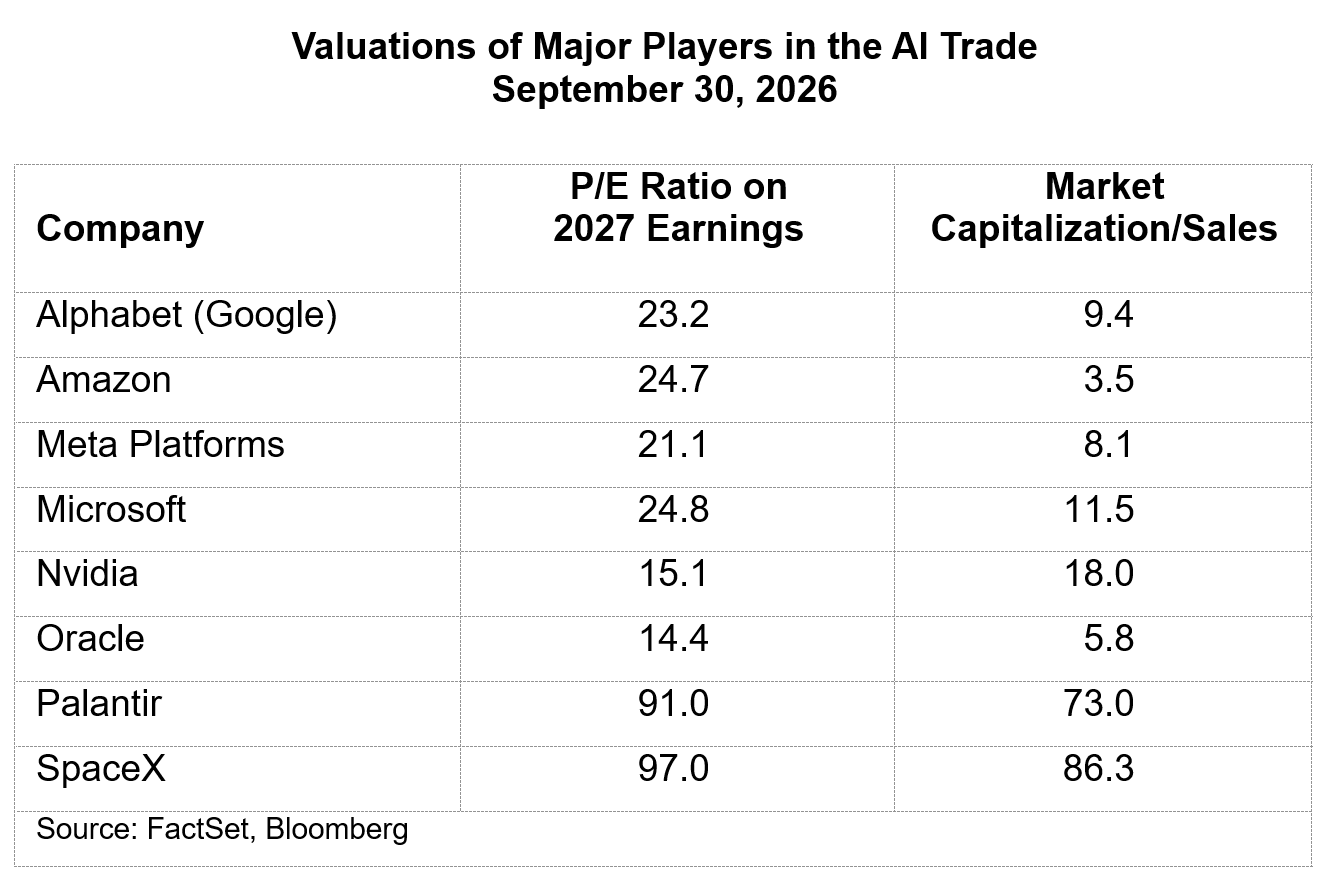
The above valuations for the major players in the AI trade show a very different picture than those of major companies in the internet bubble. The only two companies whose valuations are outliers are Palantir and SpaceX — exceptional companies, to be sure, but whose valuations reflect forecasts for enormous growth. The P/E ratios of the other six companies are quite reasonable, and the PEG ratios (P/E ratio divided by the growth rate of earnings) are modest as well (below 2:1). So, the conclusion we at BFS draw is that the AI trade does not exhibit any of the characteristics of a “bubble.”
Conclusion
Without question, we are living in the midst of one of the greatest technological revolutions ever. Like the internet, which changed the way we live our lives, AI will do the same. Rather than destroying jobs — “creative destruction” which Joseph Schumpeter wrote about in his famous book on capitalism — we believe more jobs will be created than lost by AI. We believe there will be a dramatic increase in productivity, which is one of the drivers of wealth creation. When will the AI trade come to an end? We have asked that question at various conferences hosted by investment banks, and we have yet to receive a good answer — because the answer is that no one knows. However, one strong possibility is that the AI trade will end when prices of chips, software, and tokens drop significantly due to the fast pace of technology. Andy Kessler, in a recent editorial in the Wall Street Journal, forecasted that at some point in the future the computing power of LLMs will be able to fit onto your iPhone or similar device. The speed of technological change is very rapid indeed, and if and when prices drop, the enormous sums that AI companies have borrowed and have committed to in their lease obligations and in their purchase commitments will cause some companies to falter or go under. This will cause the AI trade to subside, but there are few signs that it will end soon.
There are also risks about the harm that swarms of uncontrolled agents can do — whether through hacking, creating biological terrorism, nuclear disasters, etc. — but we are already living in an age where our enemies have stockpiles of nuclear weapons and missiles to deliver them. At BFS, we believe the risks of AI can be managed. We also believe that the data centers that the major AI players are building are nothing more than 21st century factories and that they will in fact be a boost to the communities where they are built. Finally, we think that it is important to own many of the key actors in the AI trade; most are great companies at reasonable valuations with good prospects.
Rob serves as chairman of Bradley, Foster & Sargent. He is a portfolio manager and member of the firm’s investment committee and its board of directors.
Rob founded Bradley, Foster & Sargent with Joseph D. Sargent and Timothy H. Foster. Earlier, he was president and CEO of Boston Private Bank & Trust Company, which he founded in 1985, and he spent 14 years with Citicorp, including 12 years in Europe, the Middle East, and Africa. Previously, he served as an officer in the U.S. Navy in Vietnam.
Rob served for seven years on the board of governors of the Investment Adviser Association, the national not-for-profit association founded in 1937 that exclusively represents the interests of federally registered investment advisory firms.
The Artificial Intelligence Trade
The Crash of 1929
Where is the Stock Market Headed in 2026?
People First. Then Technology
Nvidia’s Jensen Huang: The Ultimate Entrepreneur
Bill Gates and the Story of Microsoft
The Bull Market Climbs a Wall of Worry
A Painful Bear Market
Inflation: 40 Years Ago and Now
Subscribe For More Articles On
Get the latest trends and thought leadership to help you make smarter financial decisions.